Monday, 11 March 2013

Man-made Pigeon Head Tester

Ok so whilst i have been waiting for my rat to arrive (my pigeon as finally arrived already but need both to continue) I decided to have a go at making a life like on or as close as a real one as i could with things dotted around the room.
On a previous post i showed my design and the paper mache ball i made. The paper mache ball is for the head and i added (see photo below) a material chest to allow room for movement. I used a basic cotton blend fabric, something that was just lying around my house.
I then used hot glue gun to secure in place. Where they are fixed together there is a hole on the inside. This, in theory would have been big enough for a hand to control the mouth. Since this was too small and i didnt want to make the head any bigger, i decided i could secure a wooden rod so i could control the head movements.
 
 
Then i added the feathers that i brought from the Birmingham Rag market last week. They are the closest thing that ive seen to pigeon feathers. I started by adding the feathers on the bottom first so that they would lie on top of each other better. I used a hot glue gun to do this step.
 
 
However i then decided to use a hair clip for the beak. Then realised that I hadnt brought the right sized hair clip and it didnt look that good in proportion. So i decided to make a smaller version. Because this was smaller i could make it out of super sculpey - a polymer clay that needs to go in the oven to set. I made a head, neck, eyes and part of the beak all separate so i could glue it all together during the process.
 
 
Then once cool from the oven i glued the head and neck together and attached the beak. I then started to add on the feathers appropriately.
 
 
After spending a good hour individually gluing on all the feathers to the head piece i then started to tidy up the feathers and glued on the other features, again using hot glue gun. I then painted the features and this is the end product. I think it works well and could be pulled off in a video if needed. i could of potentially used a lighter material but using polymer clay allowed me to sculpt the shape instead of guessing with a balloon and paper mache!


Saturday, 9 March 2013

Other concepts of Puppets related to my practise

This video may have no relevance immediately but i thought it is important to post about it. This puppet and set in the video/ BBC children's programme called 'Playdays' isn't real-scale and is scaled down. This relates to my practise as I am planning on making a set for my creature and filming it in a simulated, scaled down environment of maybe a drain or sewer. (I really like the way the flowers move and jingle to the song it it very fitting given the target audience but that isnt relevant really!)
 

Friday, 8 March 2013

Publications & Design Team in Girl Guiding Headquarters

Friday 8th March 2013
Publications & Design Team in Girl Guiding Headquarters

The day started very early for me, as I my placement started at 9.30am I arrived in London at 8am, this gave me chance to go four stops on the Victoria line tube in rush hour. The dress code was smart but casual and on first impressions the office had a great atmosphere and all members were really friendly yet professional.

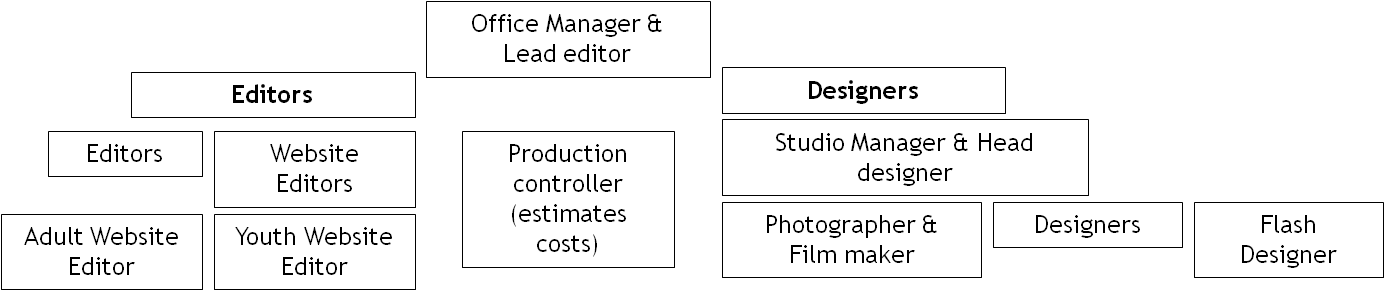
The Team

·         There are fifteen members

·         They cover a wide range of aspects of publications including the following – Guiding Magazine, young & adult members publications, online documents, downloadable PDF’s and anything else inbetween

·         In Guiding there are a wide range of publications starting for Rainbows from 5 years old way up to adult leaders up to 65 years. So the target audience changes dramatically and this affects the design, the material and the language.

·         All skills are in house, including photographer, flash gaming designer, editors etc

Process

1.       The Girl Guiding Volunteers will have a committee meeting

2.       They then talk to the editor
 
3.       They then prepare a schedule and brief

4.       They then talk to the designers about format and design

5.       The production controller estimates the cost of the item

6.    So then the editors will receive text that has been written by Girl Guiding volunteers (or previous texts if they need updating)

7.    They will then look at three elements called structure, sense and copy editing. The structure editing stage consists of introductions, different sections and headings. Sense editing is the consistency of the text, the way it flows and that it doesn’t contradicted itself, and finally the copy editing stage which is type errors spelling mistakes and grammatical errors.

8.    They then send it back to the volunteers for them to sign and approve and then sent from the editors to the designers.

9.    once the designers have finished it will be given back in a prototype format for a final check and then off to the printers (the designers will then go and see it through at the printers)  
Design

Designers are given what’s called a ‘Publications designer brief’ and this helps the designer with a successful design, it usually has the target audience age and other details like this. The more information the guidelines the designers have the better the chance of a successful design. Editors and designers work very closely together and this helps being next to each other in the same office.

The website editors have live access to all websites; there is the main website for adult members like leaders and commissioners and then the four youth websites – Rainbows, Brownies, and Guides & Senior Section. The editors of the websites work very closely with the design team especially the flash designer who designs the games for the youth website. These prove very popular with the younger girls!

They create the websites with a system called CMS (Content Management System) along side a system called DotMailer. They also use Google Analytic to measure how many times each page is viewed and on what device. Recently they have had trouble with the colouring on the downloadable PDF’s from the Senior Section website when viewed on an iPad this caused trouble for the team and are still trying to amend this. They also have increasing difficulties with the different internet providers such as Explorer, Safari, Chrome and Firefox. They have to test each server when editing the sites.

There are three main ways of creating a website, the first is with CMS, the second is known as coding and then the third is through an editor which is known as a ‘WYSIWYG’ pronounce ‘whis-ee-wig’ which is short for ‘what you see is what you get’

AFTERNOON TASK

After lunch I was allowed on a computer and design my very own interest badge. This is something that a designer was already working on but they wante my take on it as I am a member myself.

The badge was the Rainbow Overnight badge and originally looked like this, it had a historical aspect of it with the bear and the large hat.
 
I started my design by drawing a few on paper by hand


Then I started designing it on the computer using Adobe Illustrator

 
This is my final design

Girl Guiding have a very distinct style and recently have re-branded the design to keep up to date with its members. The old logo is directly below with the slogan 'girls in the lead' and then the new one is below that with the slogan 'we discover, we grow'. I really like the new logo and slogan and i feel it really does reflect the aims of Guiding, they have also incorporated it successfully into the web design.


 Examples of Publications
 
Brownie Annual 2013
 
Notice how this would appeal to Brownies that are aged 7-10 years old. In previous years there has been a foil effect on the cover but this does come at an extra cost. They tend to go for a different illustrator or designer each year to have variety.


 Camp and Holiday Scheme - A resource for adults.
 
this resource is very useful and to the point, i have used this publication myself and feel that the layout inside is very clear and precise with clear headings and useful tips in seperate boxes. There is also a very clever feature - ring binder holes to keep it nice in a folder, it also lies flat so that I can photocopy pages if needed. Notice how this is very different in design and colour because the purpuse and target audience is different.


I really learnt a great deal on my placement with regards to editorial and design based roles and how closely they work toegther to create publications that support the movement of Guiding. Guiding has continued to keep up to date with technology and the needs of the girls and leaders alike. We have a Twitter and Facebook account and we are constantly updating publications and elements to keep up to date with the girl of today and tomorrow but not forgetting our Guiding traditions.
 
Girlguiding enables girls and young women to develop their potential and to make a difference to the world.
______________________________________________

Girlguiding CHQ

17-19 Buckingham Palace Road
London SW1W 0PT
Tel: 020 7834 6242
Fax: 020 7828 8317
Email:
chq@girlguiding.org.uk
Website: www.girlguiding.org.uk


http://guidingmanual.guk.org.uk/who_we_are.aspx
http://www.girlguiding.org.uk/home.aspx


Wednesday, 6 March 2013

Inspired by David Curtis - Ring

After yesterday i was really inspired by Davids work particularly his crow from his final degree show video. He brought it with him yesterday along with some other puppets hes used and that was the one that caught my eye.
 
So i have decided (whilst i am waiting for my dead rat and pigeon to arrive) i would try something similar. I have made a start by doing a design and then ive made the head part first. Ive made it from a small balloon with paper mache on. In theory once the paper mache (tissue and pva glue) has dried the balloon can be popped and we are left with the shape of the balloon before hand. This head had to be big enough to fit an adult hand through so the bird will not be to scale. However Davids crow wasn't and this is the beauty of video! particularly in the dark - like i mentioned before - the darkness recreates the scale and environment.


Another part to this project is the animation part. I really want to do something like David suggested and use a box and make it like a sewer - please see below for my sketch...


Tuesday, 5 March 2013

Stop Motion Animation

I found this really basic video about a guilty pleasure of mine, 'Shaun the Sheep' which is shown on the children's version of the BBC. It is very similar to Wallace & Gromit but this video explains briefly about the making of the models, the making of the set, the animation process & before all that it shows about the story board being made.
 
I will have to follow a similar path if i choose to go down that route - I would really like to follow this up and have a go, tomorrow perhaps.
 
What really striked me was the fact that 12 photos make up 1 sec of an epidsode. This clearly needs very high tech equipment and knowledge.

David Curtis - Ring


Today we had David Curtis - Ring to give us a talk on his practise and how he worked his way to the position he is in now. It is clear by his website (see below for link) that he is successful - he has been involved with numberous projects with set design, costumes, props & videos so it is needless to say he has many talents and is using his gifts to good use.
 
After our talk we had the chance to have a tutorial with David & Jo Newman, this was very beneficial and I am so pleased that I signed up to have one! Some of the points we talked about was:

  • after the specimen has been created the context for display is most important, maybe using a video, photograph (or series) instead of being so static
  • we talked about producing fabric versions to almost 'practise' with
  • one thing i learnt from David is filmming in darkness re-creates, changes and distorts the environment whatever your filming. (maybe do a box with a slot at the top with light through it, with a tray of water inside to make it look like a sewer?) - i loved this idea that David gave me it would really help put my creature in context and animate him
  • Stop motion animation is a lengthly process however it is something that i have never done (like taxidermy for example!) but i really want to consider this for this project!
  • 'There There' by Radio head is the video David suggested that i researched as a basis of the principal, it shows taxidermy woodland creatures through the forest. Very inspiring for my project!

Friday, 1 March 2013

Academy - DAY 1


Today was my first placement at the local secondary school. I completed 7 hours today (8am-3pm)
 
I started by joining a year 8 class for the first lesson. This was very different to what I remember. The lessons consisted of different aspects. The lessons lasted from 8.40-9.30am.

8.40am - students are welcomed in after lining up outside sensibly

8.45am - after all students had placed all equipment out the on their desks, Mrs Elwell explained and described the first task. (They had already started the topic before half term) 

THE FIRST TASK

This was a group/ table task that consisted of four different examples of perspective scenes. They had to cut out the words/ key terms and stick it to the laminated examples. The words were as follows - horizontal line, vertical line, vanishing point, parallel lines and a few others. They had to show they were capable in working as a team to achieve the maximum result. Then as a class Mrs Elwell asked a couple of students to write on the white board (with the projection of an example) and to write the right terminology in response to it.

8.50am - Next they were set on an individual task  

THE SECOND TASK 

This was set as an individual task which consisted of a small A5 worksheet with a 2D house shape on it with a set vanishing point. The aim of this task was to make the house ‘3 Dimensional’ and to appear with ‘perspective’.

9am   -   The next step was to be set the main task for the lesson. Before they were set this Mrs Elwell showed the class examples of previous works by other students and what level they achieved by the grading criteria. She shown the class level, 3,4,5 example and it was clear to see the difference and I think that the students understood this as well.  

THE MAIN TASK 

This was to be completed on 1 sheet of A4 paper, students are required to mark their own vanishing point and horizon etc and make a street scene. And then eventually add paint/ colour.

The students were then prompted to start when I handed out the paper. Some students showed initiative and a handful was clearly showing higher than average capabilities – one student did a three-point vanishing point which caught my eye. Others on the other hand shrugged off task and needed some encouragement several times throughout the lesson.  


^ basic examples of what the students tasks were. It was extremly interesting to see how many different students took to the task, some understood straight away, some needed encouragment, and some gave up before they had a go.


9.25am – students were reminded throughout the last ten/ fifteen minutes that we will be finishing it for today so they knew how long they had left. At 9.25am the students were asked to join the biggest table and bring their work over. The discussion consisted of areas if what people found hard, what they found easy, how they could overcome and solve their challenges. They also had a group crit, this meant that students were able to say ‘what was good & not so good’ about their peers’ work. During this time Mrs Elwell spotted one particular student who wasn’t listening or paying attention. I saw first hand the ‘Discipline 1,2,3’ principal in place.


After this task students were prompted to put there equipment away and to help Mrs Elwell & I to collect the sheets and recourse's up. They then had to stand behind their chairs and then tables had the opportunity to go to their next lesson if they answered a simple task question, for example “name a term associated with perspective” and answer like “vanishing point” would suffice.


The Academy promotes a discipline 1,2,3 rule where students are given 3 warnings and then immediate consequences in a result of persistent misbehaviour.  


They also have a ‘R.E.C.I.P.E.’ for attitudes & actions for successful learning. Teachers use this a rewarding system and a basis for behaviour. Please see below -


Today was very interesting in terms of seeing what procedures they have in place and the grades that the students work towards. It also gave me a very good insight of being a teacher and living an average day as a teacher. On the basis of today i would still very much like to become an art teacher and encourage younger generations the importance of being creative. The teachers were lovely and answered any queries i had towards the placement and the career alike.

PGCE session


Jean Dyson from the Faculty of Education, Law & Social Sciences came to our campus to speak to us about the PGCE course that is on offer at BCU.
 
Some points that i made:
 
 
  • very intense course - 1 year
  • 2:2 min but 2:1 & 1st's preferred
  • very competitive - 24 places per year
  • skills tests in English and maths are required to be passed before applying
  • mentors and tutors are to hand
  • 120 days approx in school placement (2/3rds of the course)
  • 50 days approx in Uni in lectures/ workshops etc (1/3rd)
  • the above doesn't include private study time
  • the first part is 'School 1 placement' which is where students are expected to teach up to 50% of the timetable and this is usually in pairs
  • the second part is 'school 2 placement' which is where students are expected to up to 66% of the timetable and this is an individual placement
  • A substantial amount of experience is required and preferred before you apply (you also have to provide a report from a qualified teacher about your performance on this placement)
  • no social life for the period of the course! 
 

Pigeons Mannerisms Video

At the first opportunity I saw a pigeon I started to video it, its a strong example of the character and mannerisms of pigeons, and provides me the chance to replay it for future reference.


BACKSTAGE PASS

I was on the bus on the way to East side yesterday and saw this article in the metro paper.
It relates towards my project as its an interview with Tom Morris. He is asked questions about why hes made the choice he has, and what his take is on puppets - what striked me the most was the part when he stated
 
(the actors) "... are happy to stand on stage in all their glorious human charisma and believe a piece of wood is more alive then they are."